TL;DR
For years, three half-built towers in downtown Los Angeles have been a landmark for the wrong reasons, and people still ask what happened to them. This post explains what the towers are, how they ended up covered in paint, and who is responsible for them now. It also covers what the law says about painting an abandoned building.
What are the graffiti towers in Los Angeles? The short answer
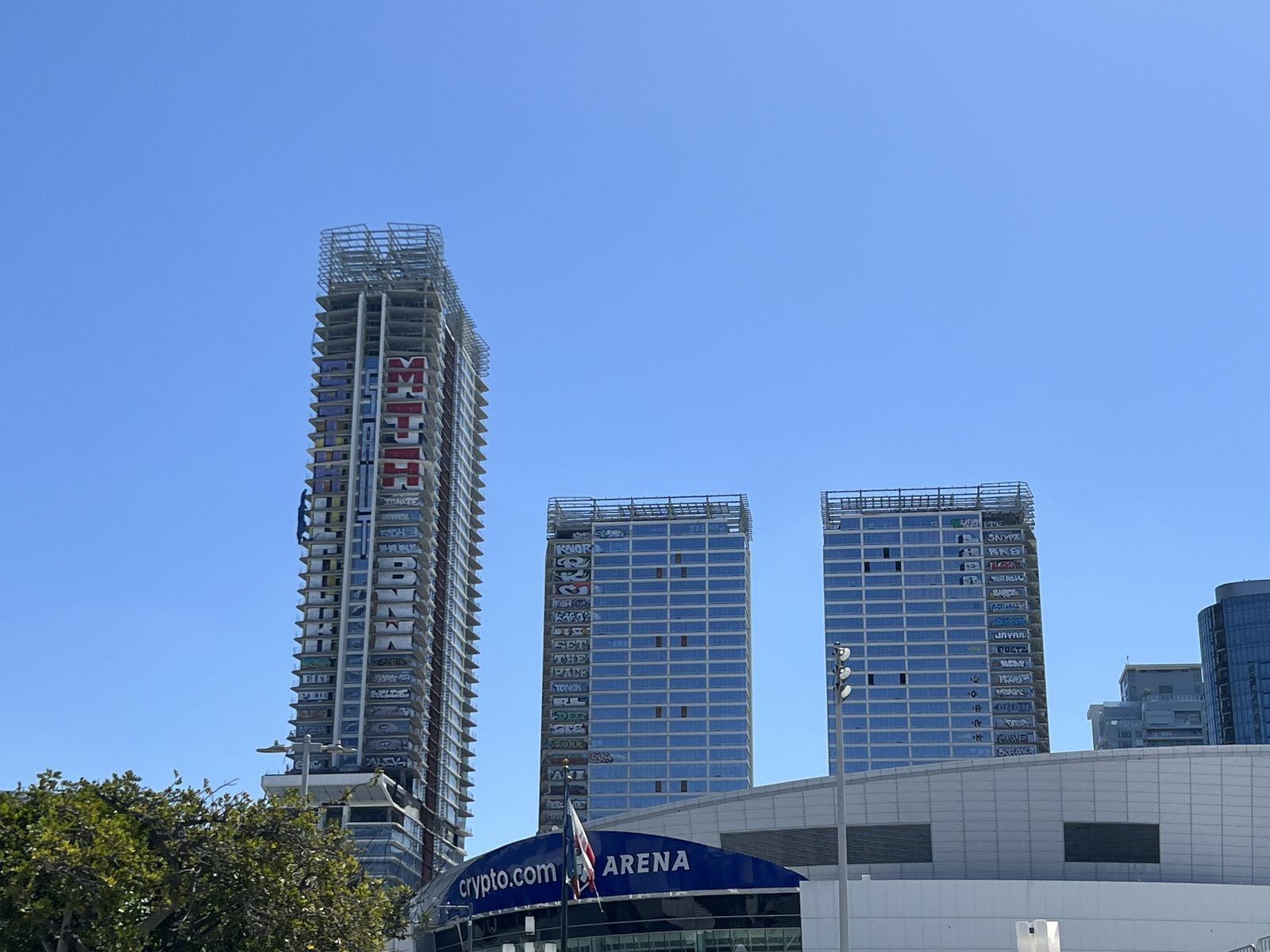
The graffiti towers are Oceanwide Plaza, an unfinished hotel, condo and shopping complex at 1101 South Flower Street, across from Crypto.com Arena. A Beijing-based developer, Oceanwide Holdings, started it in 2015 and stopped in 2019 when it ran out of money. Taggers covered at least 27 floors in early 2024. In July 2026 a bankruptcy judge cleared a sale to a joint venture of KPC Group and Lendlease, and crews began removing the paint that month. By late October 2026 most of it was gone, some traces and new tags remained, and the sale had not yet closed.
I work in digital marketing and analytics in Los Angeles, and I have painted for years, so these towers sit right where my interests meet: a stalled real estate deal, a public argument about art, and a skyline that made national news. Every claim below links to its source, and the full list is at the bottom. Nothing here is legal advice.

Where are the graffiti towers? Address and location
Oceanwide Plaza is at 1101 South Flower Street in the South Park part of downtown Los Angeles. The site fills a whole block bounded by Figueroa, Flower, 11th and 12th streets, directly across Figueroa from Crypto.com Arena and L.A. Live (The Real Deal; Los Angeles Business Journal). The Los Angeles Convention Center is a short walk south.
That location is a large part of why the towers became famous. When the tagging spread in early 2024, the Grammy Awards were days away at the arena across the street, and the Los Angeles Times headline on 1 February said so (Los Angeles Times, 1 February 2024).
Who built Oceanwide Plaza, and why did it stop?
Oceanwide Holdings, based in Beijing, launched the project in 2015 after buying the site, according to the Los Angeles Business Journal. The plan was a mixed-use complex: 504 condos in two residential towers, a 184-room luxury hotel, and about 153,000 square feet of shops. The Business Journal describes the residential towers as 40 stories each and the hotel tower as 49 stories; the sale broker’s release counts the tallest at 52 stories, so the exact figure depends on who is counting (Hilco Global release, 20 July 2026). Lendlease was the general contractor.
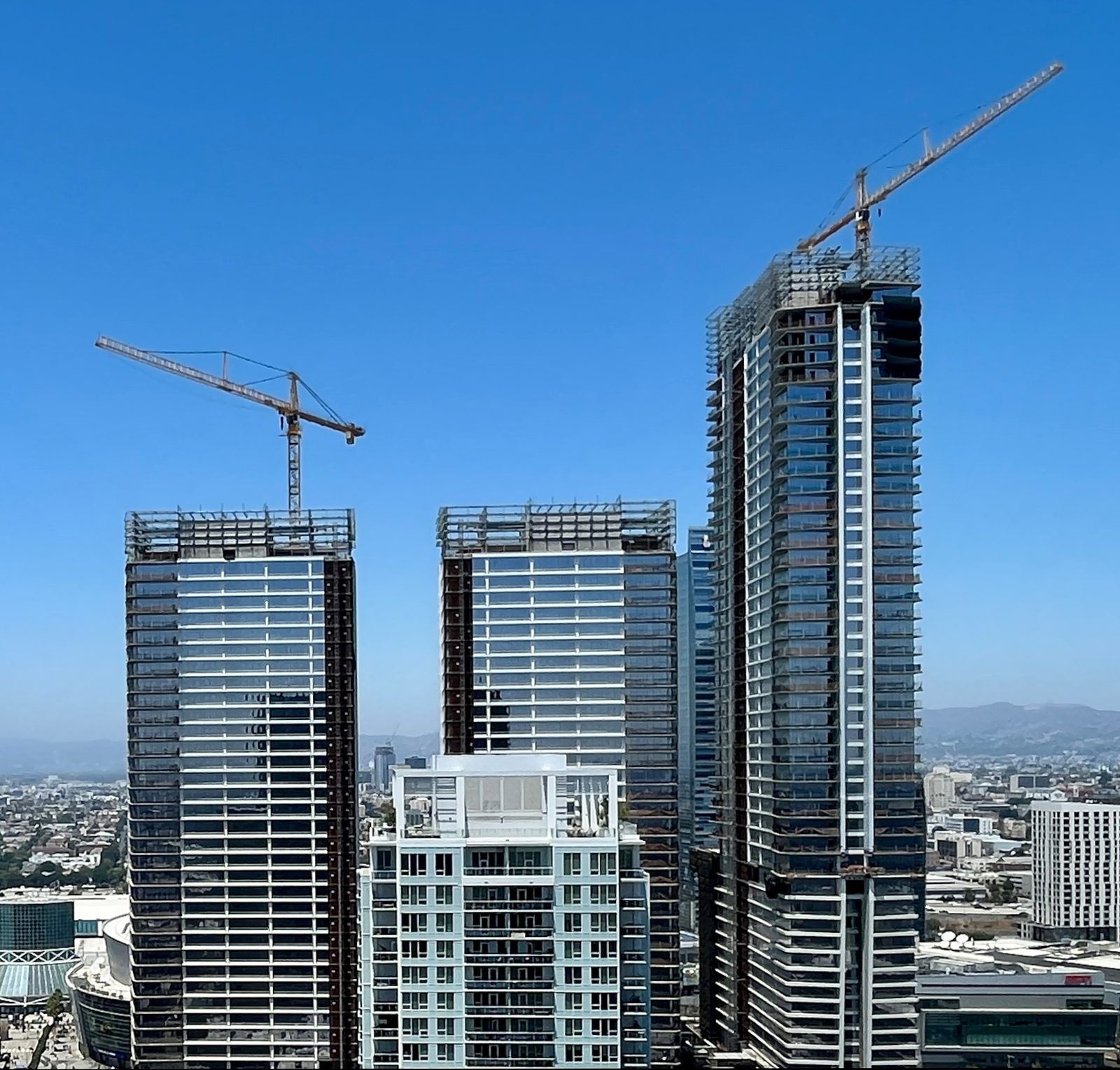

The money ran out first. The Los Angeles Times reports that Oceanwide Holdings spent about $1.2 billion before it stopped work in 2019, with the project about 60 percent complete (Los Angeles Times, 21 July 2026). Lendlease and its subcontractors were left unpaid, and liens and foreclosure suits followed. The towers stood empty behind a fence for more than four years.
How did the towers get covered in graffiti?
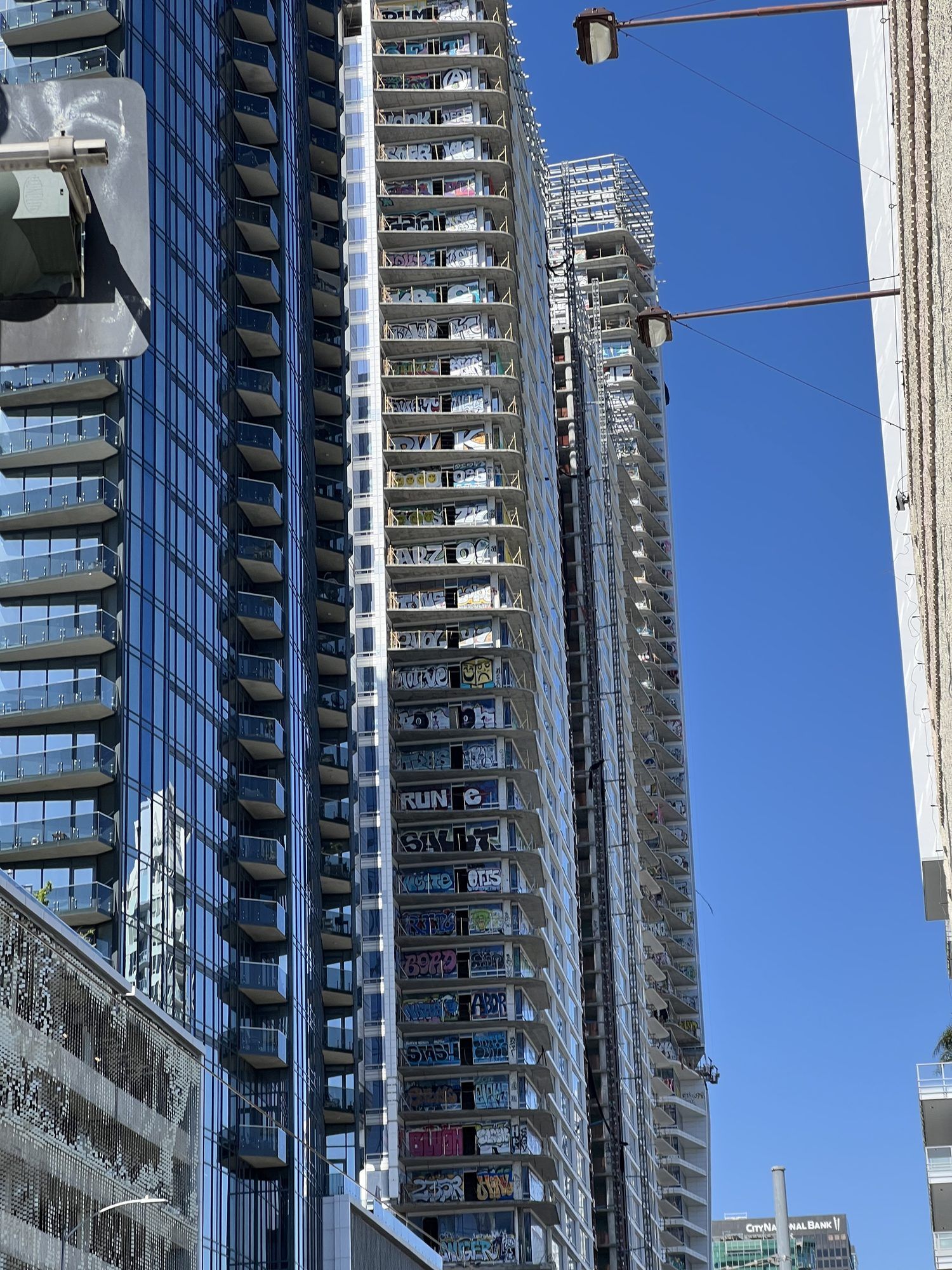
Tagging spread across the empty towers at the start of 2024. On 1 February the Los Angeles Times reported that graffiti covered at least 27 floors and that a group of young people had climbed through broken fencing that afternoon while a Times photographer watched. One tagger, who did not give his name, told the paper: “There’s no security. It’s dangerous.” (Los Angeles Times, 1 February 2024)
Hyperallergic described the towers as tagged from top to bottom in about a week (Hyperallergic, 22 February 2024). BASE jumpers parachuted from the towers, and a performer recorded himself on a slackline strung between two of the 40-story towers (Los Angeles Times, 21 July 2026).

What did the city do? Deadlines, fences and arrests
The City Council gave the developer until 17 February 2024 to start removing the graffiti, or the city would do it and send the bill (ABC7, 4 March 2025). NBC News reported that the city could not find anyone tied to the developer to secure the site. In mid-February the council also approved nearly $4 million to remove the graffiti, secure the site and restore the sidewalks, with $1.1 million set aside for fencing, scaffolding removal and security (Hyperallergic).
Police spent heavily too. NBC News reported in February 2024 that the Los Angeles Police Department had logged 3,000 hours of personnel time at the site and that 18 people had been arrested since 1 February on suspicion of offenses including trespassing and felony vandalism (NBC News, 14 February 2024). In March 2024, KNX News reported that the people arrested faced 23 criminal charges in total (KNX News, 12 March 2024).
The paint itself stayed. A year later ABC7 reported that the city never removed any of the graffiti: its Office of Community Beautification estimated about $1 million to paint over it and decided the city should not pay that cost for a privately owned building (ABC7, 4 March 2025).
Who owns the graffiti towers, and who bought them?
The towers belong to Oceanwide Plaza LLC, the company Oceanwide Holdings used for this project, which has been in Chapter 11 bankruptcy. The case began in February 2024, when Lendlease and four other unpaid contractors filed a petition against the company in the U.S. Bankruptcy Court for the Central District of California (Bisnow, 16 February 2024).
After a lengthy auction, the winning bidders filed a purchase agreement with the court in February 2026 (Los Angeles Times, 21 July 2026). They are KPC Group, a Southern California company headed by Dr. Kali Chaudhuri, and Lendlease, the original contractor (Commercial Observer, 21 July 2026), through a joint venture called KPC Square. In a May filing the City of Los Angeles argued the buyer had not shown a complete, funded plan to finish the project. It withdrew that objection on 20 July 2026, saying the buyer had agreed to begin graffiti removal immediately and close within six months (Los Angeles Times). That day Judge Deborah J. Saltzman said she would confirm the plan (Hilco Global release). Chapter 11 is the part of federal bankruptcy law used here to sell the property and pay creditors.
The price depends on the source. The court-approved broker’s release gives more than $470 million. The Business Journal breaks that down as $70 million in cash and a $400 million credit bid, meaning the secured claims of the project’s EB-5 investors (foreign investors who lent money under a federal visa program) are counted toward the price instead of cash. The Los Angeles Times and Commercial Observer report $517 million in cash and credit, ABC7 reports $517 million, and The Real Deal says the final figure is expected to pass $500 million once the deal closes. The buyers have six months from confirmation to close, with extensions possible, and they estimate another $800 million to $850 million to finish the towers (Commercial Observer; Los Angeles Times, 21 July 2026).
Mayor Karen Bass said in a statement: “I look forward to an expedited closing and the proposed buyer delivering on their commitments.” KPC’s John Petty told the Times the immediate goal is to get the complex looking nearly finished from the outside in time for the 2028 Olympics (Los Angeles Times, 21 July 2026). ABC7 reported that the complex will not open before the Games but is expected to be occupied by the end of 2028 (ABC7, 23 July 2026).
The cleanup: what has happened since July 2026?
Crews arrived on Wednesday, 22 July 2026, ahead of schedule (Los Angeles Business Journal). The Mayor’s office said the graffiti would be gone within 90 days and that the buyer, not the city, would pay (NBC Los Angeles, 21 July 2026). The Business Journal put the job at $3 million: removing paint from every window and balcony across the project.
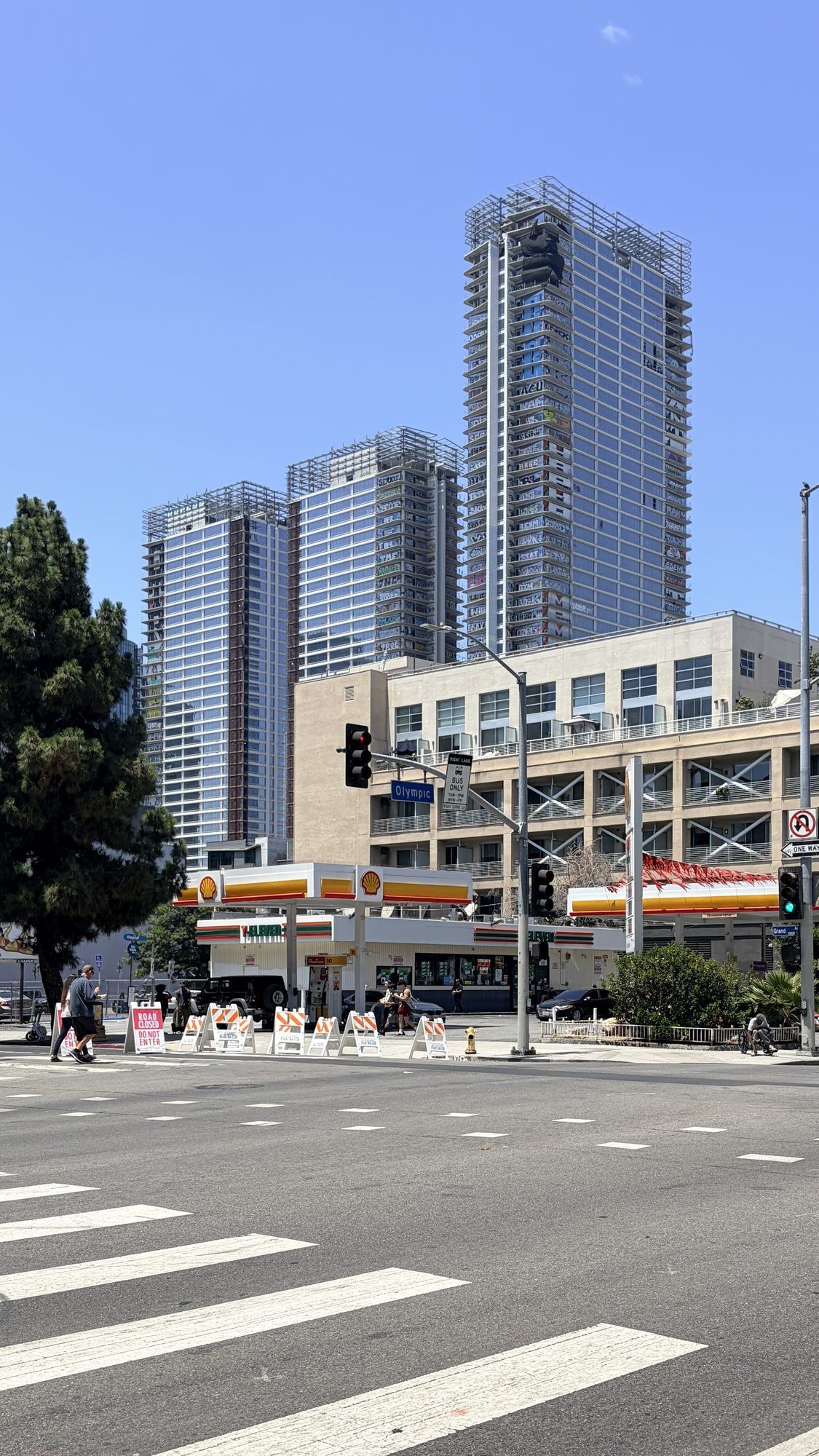

The deadline was 20 October. Before it, the original developer’s company, still the debtor in the bankruptcy, told the court in a status report that removal “has been challenging because of the methods used by the vandals and the location of the graffiti”, that the team had been enlarged with overtime, and that removal was “anticipated to be substantially complete by October 20th” (The Real Deal, 24 October 2026).
The latest reports describe a job that is mostly, not completely, done:
- The Real Deal, 24 October 2026: the towers “are no longer riddled with graffiti, but there is still some graffiti and traces of tags, too.” The joint venture did not say when the work would be finished. A local business journalist’s social media exchange suggested some tags were new, painted after crews had cleaned. The sale remains under the bankruptcy court, which had another hearing in the case set for the following week.
- South Park Neighborhood Association, 23 October 2026: “If you look up today, you will see most of the graffiti has now been removed,” with “substantial work ahead” (SPNA).
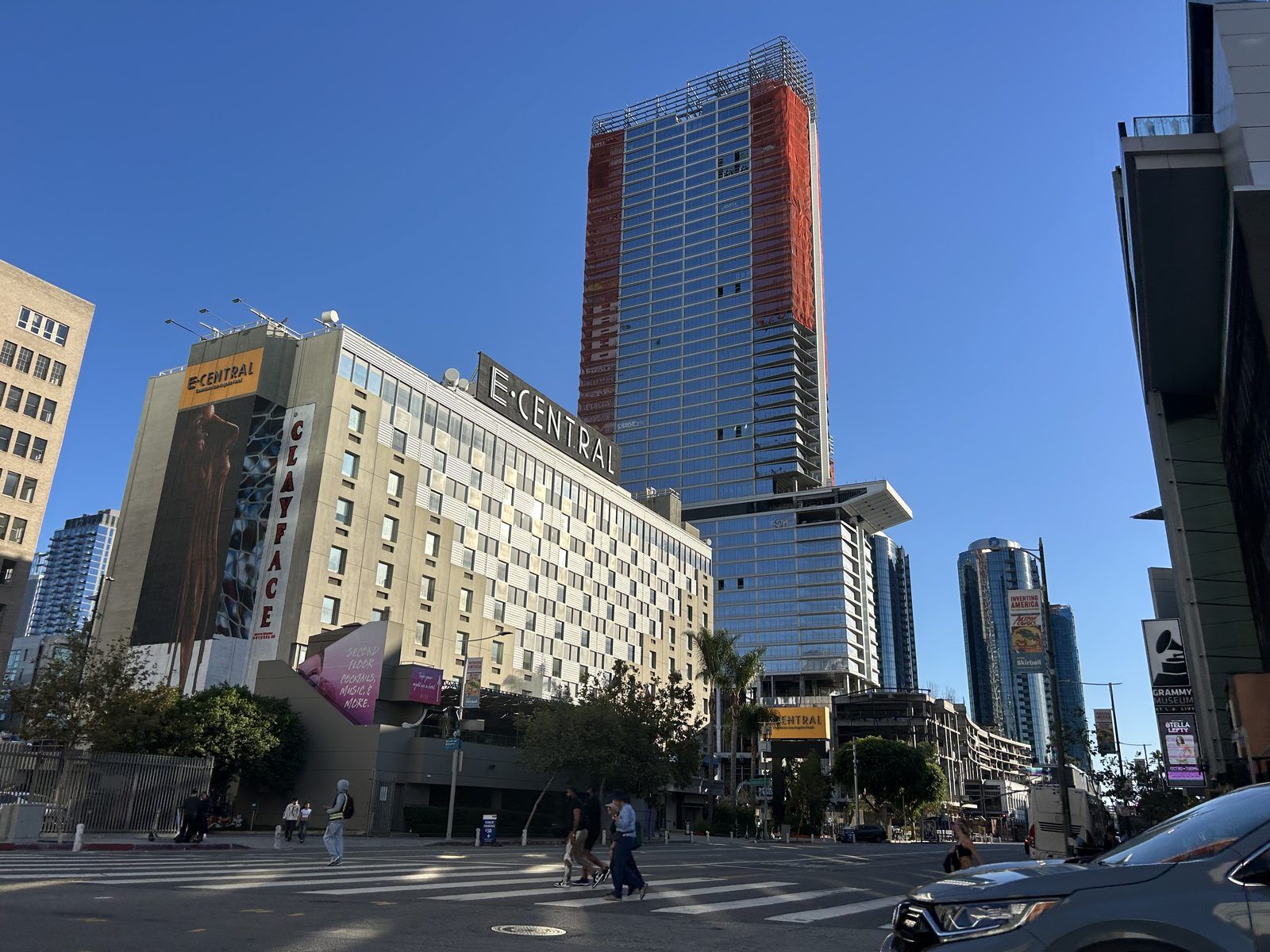

What is still unknown as of 31 October 2026: whether the sale has closed, when the last traces will be removed, how the site will be kept clean if new tags keep appearing, and when construction will restart. Petty told the Times construction starts after the sale closes.
A tourist attraction, a video game and a debate about art
For a while the towers were a destination. An NBC News headline in February 2024 asked whether they were “L.A.’s newest tourist attraction”, and the story described crowds near 11th and Figueroa looking up at them (NBC News). In May 2025, Time Out reported that announcement footage for the Los Angeles level of Tony Hawk’s Pro Skater 3 + 4 shows a graffiti-covered skyscraper in the background that “looks unmistakably like the beleaguered Oceanwide Plaza buildings” (Time Out, 1 May 2025).
People disagreed about what the paint meant. Stefano Bloch, a University of Arizona professor who teaches criminology from a cultural and geographic perspective, told the Los Angeles Times: “It’s people making use of the things that others neglect or leave behind.” The street art gallerist and curator Roger Gastman criticized the city’s spending, writing on Instagram that “there are too many to mention communities in Los Angeles that need help” (Hyperallergic). On the other side, Cassy Horton of the Downtown Residents Association called the complex “a massive beacon of lawlessness and dysfunction” (Los Angeles Times, 21 July 2026).
Even the buyer hedged. “There’s some incredible artwork on that building, and we are paying respect to the graffiti artists,” Petty said, describing a planned coffee table book.
As I see it, both sides describe the same thing. The towers were vandalism, and they were also the largest shared canvas Los Angeles graffiti writers have had, painted in a place the whole city could see. That is the same split I write about in what brand budgets say about graffiti as art: one budget pays to erase it, another pays to sell the look.
Is graffiti illegal on an abandoned building?
An abandoned or unfinished building still has an owner, and California law protects it the same way. Penal Code 594 says a person who maliciously “defaces with graffiti or other inscribed material” property that is not their own commits vandalism. Damage of $400 or more can bring jail or a fine of up to $10,000, and less than $400 up to a year in county jail or a fine of up to $1,000. A court can also order the person to clean up or repair the damage.
Getting inside is a separate offense. Penal Code 602 lists trespass offenses, including “entering and occupying real property or structures of any kind without the consent of the owner.” Whether a building is finished, empty or in bankruptcy does not appear in either section.
I am not a lawyer. For who owns the art itself once it is on a wall, see can you copyright graffiti?, and for what can happen when a building owner destroys permitted work, the 5Pointz case.
Why is there so much graffiti in Los Angeles?
There is no single cause on record, but the city’s numbers show how steady the demand for cleanup is. The data site Crosstown, working from the city’s public MyLA311 records, counted 317,372 graffiti reports in 2024, slightly fewer than in 2023 and the lowest count since 2018 (Crosstown, 20 February 2025). Boyle Heights had the most, with more than 29,000 cleanups, and downtown was the only other neighborhood above 20,000.
Even during the towers story, downtown was not the most tagged area. Crosstown found that Boyle Heights logged more reports than downtown in the first weeks of 2024 too (Crosstown, 26 February 2024). The counts include tags that crews paint over before anyone reports them, so they measure the city’s cleanup work as much as the tagging itself. What the city spends on that work is covered in my post on graffiti and brand budgets.
What it means
To me, the graffiti towers were never really a graffiti story. They were a financing story that graffiti made visible. A project that had already cost about $1.2 billion sat unfinished for years across from a major arena, and it took names on the windows to make most people look up. Then it took a bankruptcy case, a sale and a buyer’s promise to the court before the paint started coming off.
As of the end of October 2026, the towers are mostly clean, the sale is approved but not closed, and the next deadline that matters is the 2028 Olympics. I will update this post when the sale closes or construction restarts.
Related reading
- Is graffiti art? What brand budgets say, on what cities spend to remove graffiti and what brands spend to borrow it.
- Can you copyright graffiti?, on who owns the art once it is on a wall.
- Graffiti lawsuits against brands, the overview of artists who sued.
- The 5Pointz lawsuit and the Visual Artists Rights Act, the case where a developer paid for erasing permitted graffiti.
- Graffiti art in galleries, on how the art form moved indoors.
Sources
Retrieved 2026-10-31. The story is still moving; dates are given for each report. This post is not legal advice.
- Los Angeles Business Journal, Cleanup begins on Oceanwide as sale looms, 27 July 2026.
- The Real Deal, Graffiti Towers no longer?, 24 October 2026.
- Hilco Global via GlobeNewswire (Yahoo Finance copy), Oceanwide Plaza bankruptcy court confirms plan of liquidation, clearing way for $470 million sale to KPC Square, press release, 20 July 2026 (the court-approved broker; U.S. Bankruptcy Court, Central District of California, case 2:24-bk-11057-DS).
- Los Angeles Times, Roger Vincent, Graffiti towers set to be cleared for cleanup and sale, 21 July 2026.
- Commercial Observer, Patrick Sisson, Oceanwide Plaza sale set to advance after L.A. drops objections, 21 July 2026.
- NBC Los Angeles, Lolita Lopez, ‘Graffiti towers’ in downtown LA to be cleaned up in 90 days, 21 July 2026.
- ABC7 Los Angeles, Rob Hayes, Cleanup begins on infamous graffiti towers in downtown Los Angeles, 23 July 2026.
- South Park Neighborhood Association, The missing buyers: what’s holding back downtown’s recovery, blog post dated 23 October (2026).
- Los Angeles Times, Summer Lin, Taggers seen in action at graffiti-covered L.A. skyscraper, 1 February 2024.
- Hyperallergic, Matt Stromberg, the LA City Council vote to clean graffiti from the Oceanwide Plaza towers, 22 February 2024.
- NBC News, Alicia Victoria Lozano, L.A.’s newest tourist attraction? Abandoned high-rises covered in graffiti, 14 February 2024.
- KNX News, People arrested at DTLA ‘graffiti towers’ face 23 charges, 12 March 2024.
- Bisnow, Bianca Barragan, Oceanwide Plaza creditors file to force sale of abandoned downtown LA project site, 16 February 2024.
- ABC7 Los Angeles, Kevin Ozebek, Why haven’t downtown Los Angeles’s graffiti-covered towers been cleaned up?, 4 March 2025.
- Time Out, Michael Juliano, Downtown L.A.’s infamous graffiti towers are being immortalized in a new Tony Hawk game, 1 May 2025.
- California Legislative Information, Penal Code 594 (vandalism) and Penal Code 602 (trespass), statute text.
- Crosstown, Los Angeles sees slight decline in annual graffiti calls, 20 February 2025, and Downtown graffiti grabs headlines, but numbers in Los Angeles stay steady, 26 February 2024.
- Images: Sewageboy, Oceanwide Graffiti 1 and Oceanwide Graffiti 2, CC0; Benoit Prieur, Oceanwide Plaza III, II, I from Aven (July 2022), CC0; Alexis Doine, Graffiti on Oceanwide Plaza (Los Angeles) July 2026, CC0; Busimage, South Park Downtown Los Angeles (October 2026), CC BY 4.0. All via Wikimedia Commons. The graffiti in them is by various writers; the photo licenses do not cover it.
Frequently asked questions
Where are the graffiti towers in Los Angeles?
Oceanwide Plaza sits at 1101 South Flower Street in downtown Los Angeles, on the block bounded by Figueroa, Flower, 11th and 12th streets. It faces Crypto.com Arena and L.A. Live in the South Park neighborhood.
Who owns the graffiti towers in LA?
The owner of record is Oceanwide Plaza LLC, the bankrupt project company of the Beijing-based developer Oceanwide Holdings. A bankruptcy judge approved its sale in July 2026, but as of late October 2026 the deal had not closed, so ownership had not yet passed to the buyers.
Who bought Oceanwide Plaza, and for how much?
The approved buyer is KPC Square, a joint venture of KPC Group, led by Kali Chaudhuri, and Lendlease, the project's original general contractor. The price is reported two ways, from more than $470 million to $517 million, because part of it is a credit bid and fees were added during the case.
Has the graffiti been removed from Oceanwide Plaza?
Mostly. Removal started in late July 2026 with a deadline of October 20. In late October, The Real Deal reported that the towers were no longer riddled with graffiti but that some tags and traces remained, and that some marks appeared to be new. No date for a full finish has been announced.
Why did construction on Oceanwide Plaza stop?
The developer ran out of money. Work began in 2015 and halted in 2019 at about 60 percent completion, after the company had spent about $1.2 billion, according to the Los Angeles Times. Contractors went unpaid, filed liens and later pushed the project into bankruptcy court.
Is graffiti illegal in abandoned buildings?
In California, an empty or unfinished building still has an owner. Penal Code 594 makes it vandalism to deface property that is not yours with graffiti, and Penal Code 602 lists entering and occupying a structure without the owner's consent as trespass. This is not legal advice.
Why is there so much graffiti in Los Angeles?
There is no single cause on record, but the scale is steady. City data analyzed by Crosstown shows about 317,000 graffiti reports in 2024, the lowest count since 2018, with Boyle Heights and downtown at the top.
Where can I see photos of the graffiti towers?
Wikimedia Commons has a category for Oceanwide Plaza with photos under free licenses, including several used in this post. News photos, such as those in the Los Angeles Times, belong to their publishers and can be viewed on the outlets' own sites.