TL;DR
People who paint on walls often wonder who owns the art once it is up, and brands copying street art has made the question urgent. This post explains what copyright covers on a wall, what it does not, and why permission and the kind of claim matter. It is not legal advice.
Can you copyright graffiti? The short answer
In general, yes. United States copyright law protects original works that are fixed in a tangible form, and paint on a wall fits that description. The right exists automatically, without registration. Graffiti made without the owner’s permission requires more care: disputes about copying a mural and disputes about destroying it involve different rights, and the cases below do not establish one rule for every unauthorized work.
I am not a lawyer, and this post is not legal advice. I am a digital marketer in Los Angeles who has painted for years, and I wrote this because the same question keeps coming up when brands copy street art. Every claim below links to its source, and the full list is at the bottom.
For the bigger picture, see my overview of lawsuits between graffiti artists and brands.
What the law says: copyright starts when the work is fixed
The Copyright Act says protection covers original works of authorship fixed in any tangible medium of expression. Its list of kinds of work includes pictorial, graphic and sculptural works, which is the category a mural or a painted piece belongs in. The same section says protection does not extend to an idea, concept, method or system, only to the expression of it.
The Copyright Office puts the practical version plainly. Its overview says protection begins automatically once an original work is fixed, and that the work must come from a human author with a minimal degree of creativity. It also lists things that are not protected, including titles, names, short phrases and slogans, familiar symbols or designs, and minor variations in lettering or coloring.
That last list matters for graffiti. A whole piece with original characters, color and composition is a different thing from a short name or a small change in how a letter is drawn. Whether a particular tag clears the bar is a question of facts, and I cannot answer it for you.
Two points follow from the statute:
- You do not have to do anything for the copyright to exist. Copyright generally begins with the author, but section 201 provides a different initial-ownership rule for work made for hire: the employer or qualifying commissioning party is treated as the author unless a signed agreement provides otherwise. Ownership can also be transferred. Paying for a painting does not by itself answer who owns its copyright.
- The owner gets a set of exclusive rights. Section 106 lists them: to copy the work, to make derivative works, to distribute copies and to display the work publicly, among others. A brand that reproduces a mural on a dress or in an ad is using one of those rights.

Does it matter that graffiti was made without permission?
Permission matters, but the answer also depends on the right being claimed. A claim about reproducing a mural is different from a claim about destroying the physical work under VARA.
One prominent dispute came in 2018. The clothing company H&M sued the graffiti writer Jason Williams, known as Revok, asking a federal court in New York to declare that he had no enforceable copyright in a Brooklyn handball-court mural that H&M had used in a campaign. Hyperallergic reported that H&M’s lawyer called the work the product of criminal conduct and said copyright protection does not extend to illegally created works. H&M withdrew the complaint on 16 March 2018 by voluntary dismissal, and said it “should have acted differently”. No court ruled. I cover that dispute in brands copying graffiti: Cavalli, Moschino and H&M.
Two law sources wrote about it that month, and they agree on the main points:
- Grossman LLP, in a 21 March 2018 post, says the question remains unresolved and that no court has squarely decided it. It says the Copyright Act requires only minimal originality and fixation, and that nothing in the text excludes works created illegally. The firm sees no clear textual basis for H&M’s position, and suggests an “unclean hands” argument may be weak where the harm falls on a third party such as the city.
- The Fashion Law, in a 29 March 2018 article, says the Act does not address whether illegally created art is protectable and has no bright-line rule. Its account of the law in 2018 described the issue as unresolved, partly because most graffiti disputes settle. That is dated commentary, not a statement of every later case.
Both mention a second case. In Tierney v. Moschino, the defense argued that protecting entirely illegal work made no sense as policy. In January 2016 the judge denied Moschino’s anti-SLAPP motion, finding that the artist had shown a likelihood of winning on the merits. The ABA Journal piece does not say whether the court considered the mural’s legality, and Grossman says the court did not resolve the illegality argument, after which the case settled.
Neither H&M’s dismissal nor the Moschino settlement decided the illegality defense on its merits. They do not establish that every unauthorized work is protected, or that none is. VARA has its own case law: the 2013 5Pointz opinion, page 8, footnote 5 cites English v. BFC&R East 11th Street LLC (1997) as denying VARA protection to illegally placed graffiti. That concerns protection of the physical work, not a general license for brands to reproduce it.
Do you have to register graffiti before you can sue?
Registration and ownership are separate. The Copyright Office says registration is voluntary, but for a US work it is needed before you can sue for infringement. The statute says the same: Section 411(a) generally bars a civil infringement suit over a US work until it has been preregistered or registered, with exceptions. One exception is a suit over the author’s rights under the Visual Artists Rights Act (section 106A(a)), which does not need prior registration. Another covers an applicant whose registration was refused.
The timing detail comes from the Supreme Court. In Fourth Estate Public Benefit Corp. v. Wall-Street.com, decided on 4 March 2019, the Court held unanimously that registration occurs when the Copyright Office registers the work, not when the owner files the application. For an artist whose mural has just been copied, that means applying is not the same as being registered.
Registration also has other effects. The Copyright Office says it creates a public record and certificate, may qualify the owner for statutory damages and attorney’s fees, and, if done within five years of publication, serves as prima facie evidence in court. On the “poor man’s copyright” idea, mailing your own work to yourself, the same page says it has no basis in copyright law and does not replace registration.
The Office’s registration portal lists visual arts among the kinds of work it registers and offers group registration for two-dimensional artwork.


What VARA adds for some physical works
Copyright protects the right to copy. The Visual Artists Rights Act, or VARA, covers a different harm: what happens to the physical work. Section 106A gives authors of covered works of visual art rights of attribution and of integrity, including the right to prevent destruction of a work of recognized stature. Those rights stay with the author even after the author sells the work or the copyright.
The best-known graffiti case under VARA is 5Pointz in Queens. The Art Newspaper reported that Judge Frederic Block awarded 21 artists $6.75 million, $150,000 for each of 45 works, after the developer whitewashed the site. That developer had let the artists paint there for over ten years, so those were permitted works. Grossman makes the same point: the 5Pointz case did not raise the illegality question because the works were made with the owner’s permission. The 5Pointz and VARA post covers the case in full.
What copyright does not protect: a style
A common mistake is to treat copyright as ownership of a look. The statute does not work that way, because it protects expression and not ideas.
The Hayuk case shows the line. The artist Maya Hayuk sued Starbucks over a campaign she said took the core of her work. A federal judge dismissed the claim on 12 January 2016, writing that the theory amounted to copying her style or ideas, which copyright does not protect. The ruling was about her specific theory, not about graffiti in general, and it is worth reading beside the Cavalli and Moschino claims, where specific pieces and signatures were allegedly copied. My post on whether you can copyright a style goes through it.
A particular piece can contain protected expression. A palette or technique alone does not give its creator ownership of a whole style.
Who owns the wall, and who owns the art?
These are two different questions, and the law treats them separately. Section 202 says ownership of a copyright is distinct from ownership of the physical object. Transferring the object, even the original copy where the work first appeared, does not by itself transfer any copyright rights, and transferring the copyright does not, without an agreement, give the new owner the object.
For a mural, that means a building owner who has a wall painted still does not automatically own the copyright in the painting. It also does not mean the owner can do anything to a covered work: VARA, above, limits destruction and alteration of some works.
Photographing murals
A mural’s visibility from the street is not by itself permission to reproduce it. The architectural-work exception was one issue in a dispute over commercial photographs. In Mercedes-Benz v. street artists, Mercedes-Benz posted photos of a truck driving past Detroit murals, and four artists had allegedly threatened to sue. Mercedes asked a court for a declaration that its depictions were lawful. A 2020 NYU law journal blog post reports that the court denied the artists’ motion to dismiss, so Mercedes’s argument stayed plausible. The argument was that the murals were part of an architectural work, and that the Architectural Works Copyright Protection Act exempts pictures of buildings visible from public places.
The post says the larger question is unsettled: either murals count as design elements of a building, or they are separate artworks whose owners must authorize photos. It does not report a final outcome. If you plan to use a photo of someone else’s mural in an ad or a product, ask a lawyer first.
What artists can do
These steps come from the sources above, not from my own legal expertise.
- Register the work. For a US work, registration is needed before an infringement suit, and the Copyright Office describes it as creating a public record and possibly qualifying you for statutory damages and fees. Do not rely on mailing the work to yourself.
- Keep dated photographs and records. This is my suggestion, not a legal rule: a photo with a date helps show what you made and when, and it helps with the registration deposit.
- Know what VARA covers. The act protects some physical works against destruction or harmful alteration, and claims under it do not need registration first.
- Talk to a lawyer before suing. The open questions above mean a lawyer can tell you more than a general post can.
What brands should do
- Get permission or a license. The Fashion Law’s advice to brands is to avoid using unauthorized graffiti. A written license from the artist is the clear path.
- Do not count on the illegality argument. H&M tried it, drew public backlash and dropped the suit a week after filing it. Moschino tried it, and the case settled without a ruling on it, according to Grossman.
- Do not copy a specific piece. A general look is not protected, as Hayuk shows, but a specific mural can contain protected expression.
- Check who the artist is and whether the work is permitted. Permitted works can also be protected by VARA, as 5Pointz shows.
What it means
Graffiti does not sit outside copyright law simply because it is painted on a wall. Original murals can contain protected expression, and brands accused of copying them have faced lawsuits. Permission, ownership, the alleged use and the particular right at issue all matter. The H&M and Moschino outcomes do not decide those questions for every wall.
That fits the pattern in my broader post on what brand budgets say about graffiti as art: a city sees a crime, and a brand sees something worth copying. Those reactions do not replace the legal analysis of a particular work and use.
Artists mentioned
The artists and estates named in this post, with their own sites and Instagram accounts:
Sources
Retrieved 2026-10-30; primary-law corrections checked 2026-11-01. Secondary sources are labeled where the text relies on them. This post is not legal advice.
-
Cornell Legal Information Institute, 17 U.S.C. 102, Subject matter of copyright, statute text.
-
U.S. Copyright Office, What is copyright?, overview page.
-
Cornell Legal Information Institute, 17 U.S.C. 106, Exclusive rights in copyrighted works, statute text.
-
Cornell Legal Information Institute, 17 U.S.C. 411, Registration and civil infringement actions, statute text.
-
Cornell Legal Information Institute, 17 U.S.C. 106A, Rights of certain authors to attribution and integrity, statute text.
-
Cornell Legal Information Institute, 17 U.S.C. 202, Ownership of copyright as distinct from ownership of material object, statute text.
-
Supreme Court of the United States, Fourth Estate Public Benefit Corp. v. Wall-Street.com, LLC, No. 17-571, opinion, 4 March 2019 (Cornell LII copy).
-
U.S. Copyright Office, Copyright FAQ: general questions.
-
U.S. Copyright Office, Registration portal.
-
Grossman LLP, Kate Lucas, H&M raises and then drops a lawsuit, Art Law Blog, 21 March 2018 (secondary, law firm commentary).
-
The Fashion Law, What rights do street artists have in illegally-created graffiti?, 29 March 2018 (secondary).
-
Hyperallergic, H&M lawsuit against street artist Revok and copyright law, 15 March 2018.
-
ABA Journal, Judge refuses to toss graffiti artist’s suit claiming designers copied Katy Perry dress, January 2016.
-
The Art Newspaper, New York judge awards 5Pointz street artists $6.75 million for whitewashed works, 13 February 2018.
-
SDNY Blog (Steptoe), Judge Swain rejects artist’s copyright claim against Starbucks over ad campaign, 13 January 2016.
-
NYU Journal of Intellectual Property and Entertainment Law blog, Francesca Masella, Mercedes-Benz v. street artists: scope of copyright protection for street art, 3 February 2020 (secondary, student commentary).
-
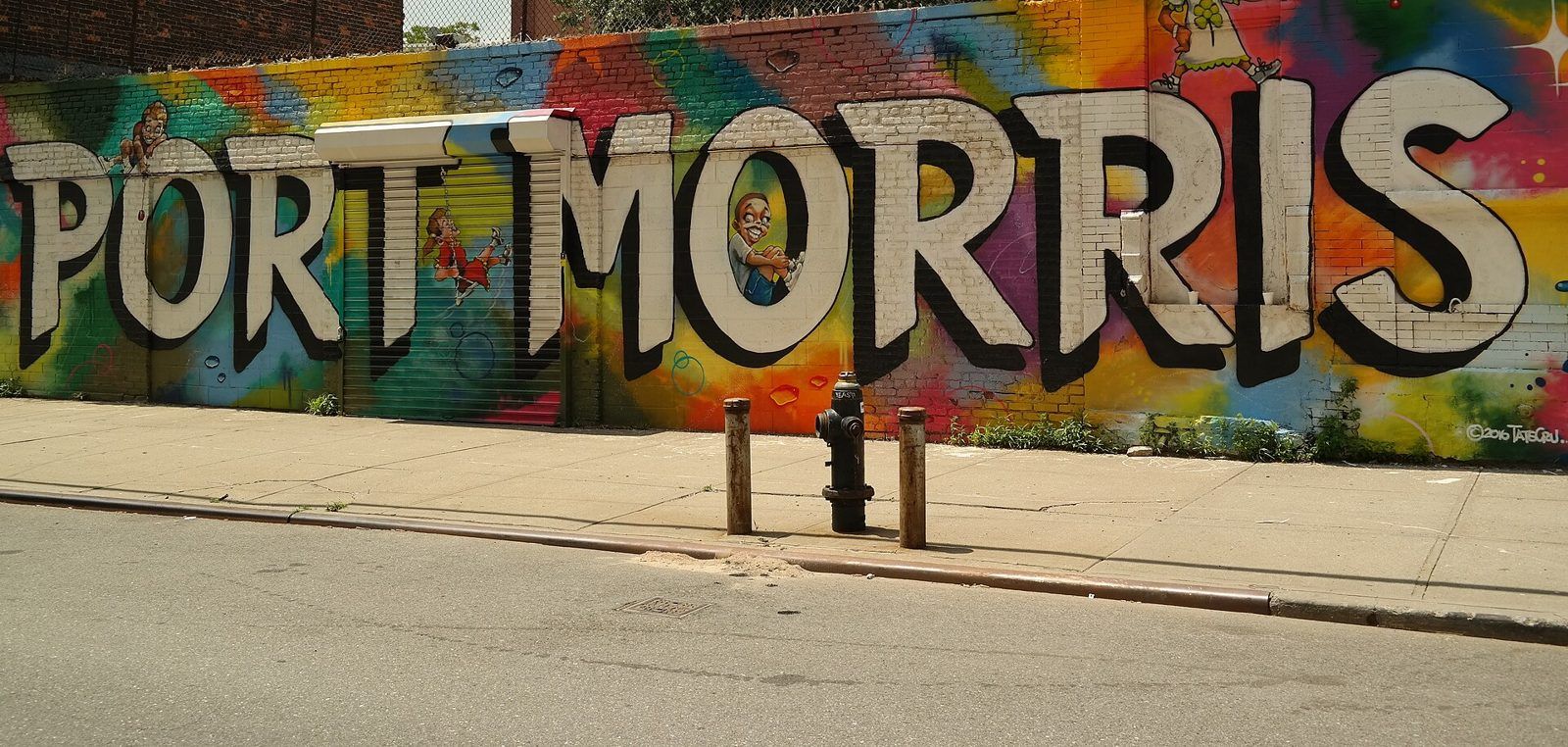
Image: Jeff Reuben, Port Morris by TATS CRU.jpg, Wikimedia Commons, CC BY-SA 4.0. The mural belongs to Tats Cru; the photo license does not cover it.
-
Cornell Legal Information Institute, 17 U.S.C. 201, Ownership of copyright, initial ownership, work made for hire and transfers.
-
U.S. District Court, E.D.N.Y., Cohen v. G&M Realty, No. 13-CV-5612, memorandum of 20 November 2013, page 8, footnote 5 (English and unauthorized graffiti); official GovInfo copy.
Frequently asked questions
Is graffiti copyrighted?
In general, yes. US copyright protection covers original works fixed in a tangible medium of expression, and the statute's list of works includes pictorial and graphic works. Paint on a wall is fixed, so an original piece can qualify. Graffiti made without the owner's permission raises different questions for reproduction copyright and for protection against destruction. H&M's dismissal did not resolve the reproduction question; a separate VARA case denied protection to illegally placed art.
Can you copyright graffiti?
The copyright exists automatically when the original work is made and fixed, so you do not have to apply for it. You can register it with the US Copyright Office, and for a US work registration is needed before you can sue for infringement. This is not legal advice.
Is illegal graffiti copyright protected?
H&M argued in 2018 that a mural made through criminal conduct had no enforceable copyright, then dropped its suit without a decision on that argument. That outcome does not establish a rule for every unauthorized mural. VARA is different: English v. BFC&R denied its protection to illegally placed art. A lawyer should assess the work and the particular claim.
Is street art copyrighted?
The same rules apply to murals and street art as to other original artwork: protection begins when the work is fixed. What differs is the extra layer for some physical works. The Visual Artists Rights Act, for example, covers certain rights to attribution and against destruction, as in the 5Pointz case.
Do you need to register graffiti to have a copyright?
No. The Copyright Office says copyright exists without registration. But for US works, registration (or a refusal of registration) is needed before you can file an infringement suit, and the Supreme Court held in 2019 that registration happens when the Copyright Office acts, not when you file the application. Claims under the Visual Artists Rights Act are an exception to the registration rule.
If I own the wall, do I own the graffiti on it?
You own the physical wall, but not automatically the copyright in the art. The Copyright Act treats ownership of the copyright as distinct from ownership of the physical object. Separate rules in the Visual Artists Rights Act can also limit what an owner may do to some works on a wall.
Can you copyright a graffiti style?
No. Copyright protects expression, not ideas, and in 2016 a federal judge dismissed Maya Hayuk's claim against Starbucks on the view that her theory amounted to copying her style or ideas. A specific piece is protected, but the look of a whole genre is not.
Can a brand use a graffiti mural in an ad?
Brands that used murals without permission have been sued, and several disputes ended in settlements, including Cavalli and Moschino. The Fashion Law's advice to brands is to avoid using unauthorized graffiti. Getting permission or a license from the artist is the straightforward route.
Can I photograph a mural and post it?
There is no clear answer yet. A 2020 legal blog notes that courts have not settled whether murals visible from the street count as part of a building, which would bring in the rules about photographing buildings, or as separate artworks. This is not legal advice, so ask a lawyer before using a mural photo commercially.