TL;DR
The muralist Maya Hayuk sued Starbucks, saying its ads copied the look of her paintings, and a federal judge dismissed the case. It shows where copyright stops: it covers a specific work, not a shared look. The ruling does not say brands may copy living artists freely, and it does not mention graffiti.
The short answer
No, you cannot copyright an art style. In Hayuk v. Starbucks, a New York federal court dismissed a muralist’s suit over Starbucks ads that echoed her bright, layered rays of color. Her paintings are protected as specific works. The general look they share with other work is not.
The sources are the court’s opinion, which a law firm posted as a PDF, and a second source that summarizes it. This is a report of one ruling, not legal advice.
I work in digital marketing in Los Angeles and I paint, so this case sits where both of my worlds meet. It also belongs to a larger story I follow on this site, in which brands copy and pay for graffiti-style looks while courts decide where the line is. The hub article on graffiti lawsuits against brands puts the cases side by side.
What Maya Hayuk said Starbucks did
Maya Hayuk is a visual artist who, in the court’s words, is often commissioned to paint murals. The opinion says she made five works between 2009 and 2011 and registered the copyright in each: Hands Across the Universe (Portrait of the Aura of Imam Bowie), The Universe, The Universe II, Sexy Gazebo and Kites #1. The ABA Journal describes her as a New York artist known for kaleidoscopic, brightly colored murals.

The court summarized her story from the complaint. On 10 October 2014 the ad agency 72andSunny emailed her to ask whether she would create artwork for a proposed Starbucks campaign. After talks between her lawyer and the agency, she declined on 20 October 2014. She alleged that Starbucks then made art substantially similar to hers anyway, and that the result was the Frappuccino campaign: artwork on cups, websites and store signage, plus short promotional videos.
She sued on 23 June 2015. The complaint made five copyright claims against each defendant, one per painting, and one contributory infringement claim against 72andSunny. She asked for an injunction, money damages including statutory damages, and legal fees. According to the American University Business Law Review, Starbucks launched the Mini Frappuccino in May 2015 with a cup carrying a bright, geometric ray graphic.
The defendants moved to dismiss, arguing that the ads were not substantially similar to her works as a matter of law.
What the judge decided
Judge Laura Taylor Swain heard oral argument on 17 December 2015 and, on 12 January 2016, granted the motion. The opinion dismisses the complaint “in its entirety” and tells the clerk to enter judgment for the defendants and close the case.
The court did not say Starbucks never saw her work or never talked to her. It decided a narrower question: whether the ads were “substantially similar” to the protectable parts of her paintings. Here is how the opinion gets to no.
Hayuk did not claim an exact copy. The opinion says she did not claim that any ad was an exact copy of any part of her works. She argued instead that the ads took the “total concept and feel” of her paintings, and, in her words as the court reports them, the “core” of her work.
The court would not treat a look as protected. The judge wrote that Hayuk had not cited precedent for the idea that taking the “core” of a work or set of works is a basis for infringement. She also had not explained how that “core” differed from saying the defendants copied her style or elements of her ideas, which the opinion says copyright law does not protect. What copyright protects, it says, is particular expressions of ideas.
Raw materials are free to everyone. The opinion treats colors and “the catalogue of geometric forms” as raw materials in the public domain. Hayuk’s paintings use circles, lines, rays, colors and textures, and the court said those basic elements of artistic creation are not protectable. Being fine art, it added, does not make a whole work protected, and Hayuk cited nothing for that idea.
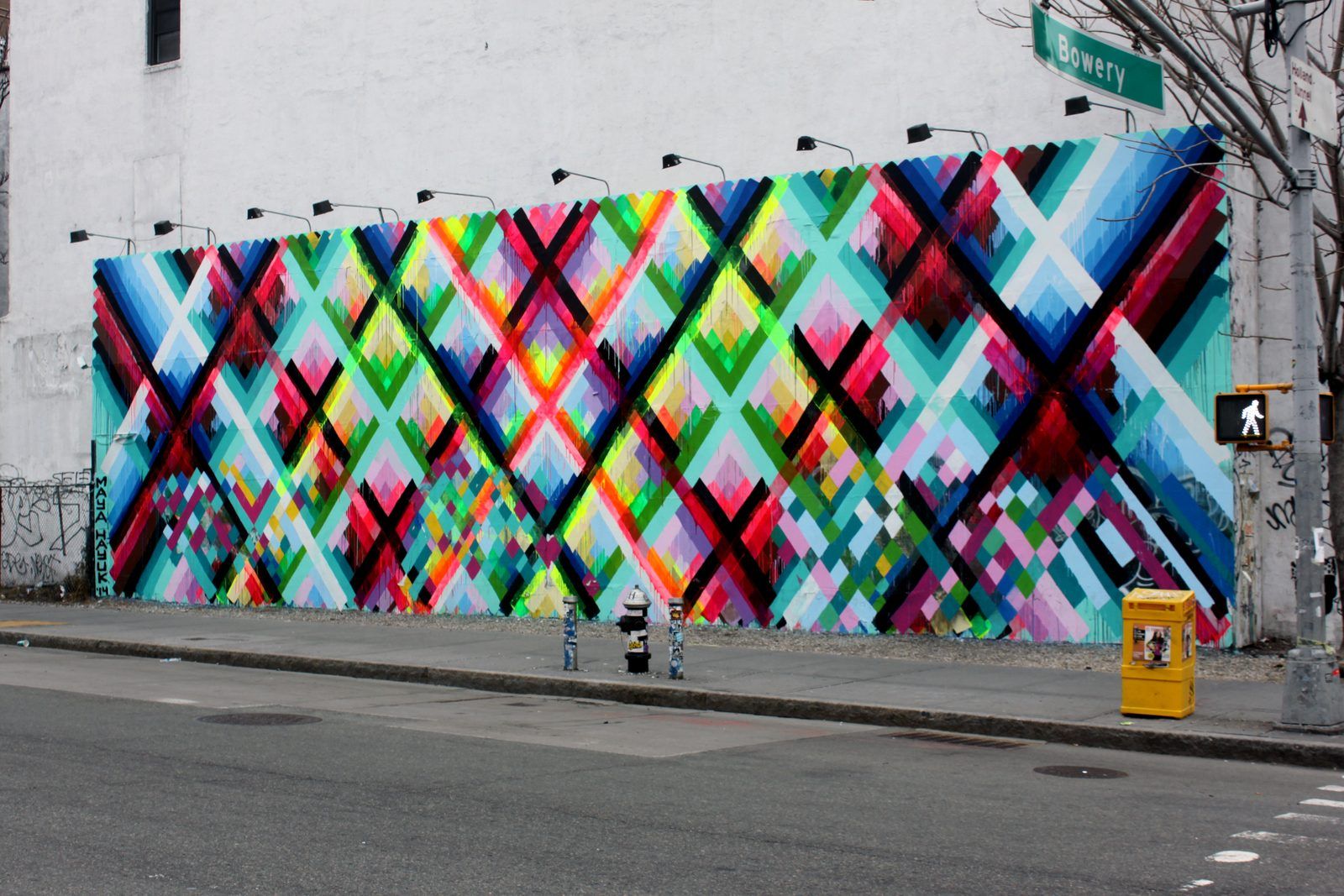
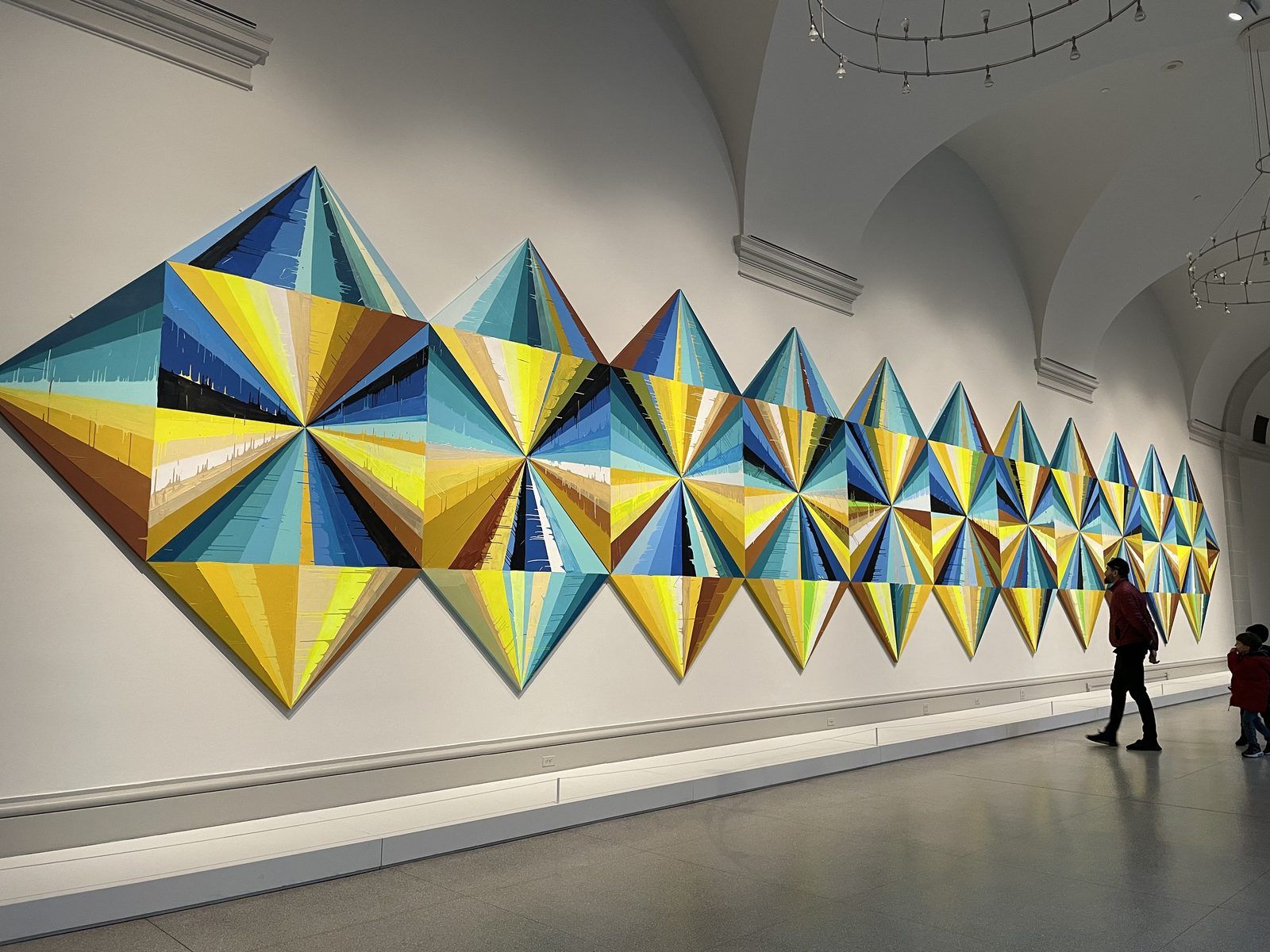
Overlap was real but general. The court said the two sets of works share overlapping colored rays “in a general sense,” and put that in the unprotectable category of raw materials or ideas. It then pointed to what the ads did not do. None of them had the diamond-shaped center of the three Universe paintings, with rays ending in rounded shapes holding planet-like circles. None had Kites #1’s central quadrilateral of intersecting lines, or the intersecting diamonds of Sexy Gazebo. In the court’s phrase, the “far more dominant dissimilarities in the specific aesthetic choices” decided it.
Cropping and rotating did not help. Hayuk’s complaint put crops and rotations of small parts of her paintings next to the ads. The court said the test looks at the works as a whole, so showing that an angle appears somewhere inside a painting does not carry a claim.
The videos did not change it. She also compared animated lines in the Frappuccino videos with her static paintings. The court said that comparison failed to show substantial similarity of the moving images to the total look and feel of any painting.
Because no direct claim survived, the contributory infringement claim against 72andSunny fell too. The American University review’s author thinks the court may have gone too far in saying no reasonable jury could find similarity, and still agrees with the result because the campaign resembles her work only slightly. That is one commentator’s view, and it shows that reasonable readers can weigh the pictures differently.
What it means for artists whose style gets copied
The honest reading for artists is uncomfortable. If your recognizable look is a method, a palette and a set of shapes, this opinion says that look alone is not what copyright protects. Your specific paintings are protected. A client who borrows the feeling without borrowing a piece may not be copying anything the law covers.
The opinion points at what artists can do about it. The court was looking for similarity in the particular choices of a work: how lines meet, where the center sits, what ends in a circle. The more particular your piece is, the more there is to compare. I am not saying that would have won this case. I am saying the opinion’s test is built from those details.
I would add one practical point from my side of the desk, and it is opinion, not law. A brief that says “make it look like this artist” is a risk for a brand, and a clean way to avoid it is to hire the artist. Hayuk had been asked to do exactly that, and said no.
What it means for brands
For a brand, the opinion shows how a style-based claim can end early. Starbucks won on a motion to dismiss because the judge could compare the works attached to the complaint and decide.
I would not read it as permission. The court decided this comparison, with these ads and these paintings. It also did not hold that the allegations about the email were false. A brand that borrows heavily from one named artist after talks fell through is still a story that gets published, and it is the kind of story that the rest of this series covers.
How this connects to graffiti
Hayuk is a muralist, and no source calls her a graffiti writer, so this is a comparison, not a case about graffiti. The opinion never mentions graffiti.
The comparison is still useful. A lot of what makes graffiti recognizable is a look: a way of building letters, a color habit, a layout. The Hayuk opinion says that kind of look is where protection thins out. That helps explain how a brand can commission something that reads as street-made. I am describing the logic, not a ruling about graffiti. I covered the money side in the post on brand budgets and graffiti, and the copyright basics in can you copyright graffiti.
The contrast is the Cavalli case. In Williams v. Roberto Cavalli S.p.A. (C.D. Cal. 14-cv-06659), three artists said Just Cavalli clothing used high-resolution photos of their San Francisco mural, printed on garments, with the signatures of Revok and Steel rearranged until they could not be read. Rebecca Tushnet’s blog reports that on 12 February 2015 the court rejected a motion by some defendants to dismiss the claims other than copyright infringement, including the claim about removing copyright management information. The artists’ claims there were about their actual mural being copied, not about a style, and the court let the claims it was asked to dismiss go forward.
Put the two side by side and the line is the one the Hayuk opinion draws. Taking a specific work is one thing. Echoing a look is another. Neither opinion tells you where that line falls for a given piece, and the Cavalli ruling was only an early step, not a finding that anyone infringed.
What the case does not settle
I want to be clear about the limits, because short headlines flatten them.
- It is one trial court’s opinion on a motion to dismiss. No appeal has been reported. Wikipedia says Hayuk later asked the judge to reconsider; the outcome is unconfirmed.
- The court did not rule on how the Starbucks art was made or who saw what. It took her allegations as given and compared the pictures.
- It does not say all style copying is fine. The opinion says copyright protects particular expressions, and that is the door a different artist could walk through with a different set of facts.
- It is not about graffiti, murals on public walls, or the Visual Artists Rights Act, which is a separate law about destroying works.
- It cannot tell you whether your own copying or your own work is safe. That takes a lawyer who has the pictures.
What it means
You can copyright a mural, and the Hayuk opinion treats her paintings as protected works. You cannot copyright a style, and the same opinion says that is why her suit failed. The practical edge sits in the specifics: how close a copy is to one piece, not how close it feels to a body of work.
Here is my reading, as a painter and a marketer. Brands pay for the look of the street and the studio because it works, and this opinion gives that look less protection than the people who made it might expect. That gap is the subject of this whole series, and I would rather lay out what the court said than guess at what it should have said.
Artists mentioned
The artists and estates named in this post, with their own sites and Instagram accounts where I have confirmed them:
Sources
Retrieved 2026-10-30. The opinion is the primary source for what the court held.
- Judge Laura Taylor Swain, Memorandum Opinion and Order, Hayuk v. Starbucks Corp. and 72andSunny Partners, LLC, No. 15 Civ. 4887 (LTS), Doc. 37, S.D.N.Y., 12 January 2016 (PDF posted by Steptoe).
- American University Business Law Review, Luck runs out on Hayuk: Hayuk v. Starbucks Corp., February 2016 (secondary).
- ABA Journal, Artist sues Starbucks, says chain used substantially similar art for coffee, 26 June 2015.
- Wikipedia, Maya Hayuk (secondary, for her description as a muralist and the reported request to reconsider).
- Rebecca Tushnet, Copying graffiti could infringe copyright and trademark, Tushnet’s blog, 2 March 2015 (secondary, on Williams v. Roberto Cavalli S.p.A., No. 14-cv-06659, C.D. Cal., 12 February 2015).
Frequently asked questions
Can you copyright an art style?
In Hayuk v. Starbucks, a federal court in New York said no. The opinion states that copying an artist's style or elements of her ideas is not protected by copyright law, and that copyright protects particular expressions of ideas. A specific painting or mural is protected, but a general look built from colors, lines and shapes is not. This is a report of one ruling, not legal advice.
What was Hayuk v. Starbucks about?
Maya Hayuk, a New York artist, sued Starbucks and the ad agency 72andSunny on 23 June 2015. She said Starbucks's Frappuccino advertising, which used colored rays on cups, signage and videos, infringed five of her paintings from 2009 to 2011. She also alleged that the agency had approached her in 2014 about the campaign and that she declined.
Who won Hayuk v. Starbucks?
Starbucks and 72andSunny. On 12 January 2016 Judge Laura Taylor Swain granted their motion to dismiss, dismissed the complaint in its entirety, and directed the clerk to enter judgment for the defendants and close the case. No appeal has been reported.
Why did the court say Starbucks did not copy Hayuk?
The court compared the works themselves. It found that both use overlapping colored rays in a general sense, but it treated that as unprotectable raw material or ideas. It found the specific aesthetic choices far more different than alike: none of the ads had the diamond-shaped center with planet-like circles of the Universe works, the central quadrilateral of Kites #1, or the intersecting diamonds of Sexy Gazebo.
Is copying an artist's style legal?
Hayuk v. Starbucks says a style alone is not protected by copyright. That does not mean anything goes. The same opinion says copyright protects particular expressions, and a different court let claims proceed in the Cavalli graffiti case, where artists alleged that their actual mural was photographed and printed on clothing. Whether a particular copy is legal depends on the facts, so ask a lawyer.
Is Maya Hayuk a graffiti artist?
No source calls her a graffiti writer. The ABA Journal describes her as a New York artist known for kaleidoscopic, brightly colored murals, and Wikipedia describes bold geometric patterns in large-scale murals. The case matters to graffiti because it is about murals and style, not because of how she is labeled.
Does the Hayuk ruling apply to graffiti?
The opinion does not mention graffiti, so any link is my reading, not a holding. The logic it states, that an artist's recognizable look is not protected while a specific work is, is the same question graffiti writers face when a brand borrows a lettering look rather than a piece.
Did the court say the Starbucks art was original?
No. The court did not decide who was inspired by whom. At this stage it took Hayuk's allegations as the facts and asked only whether the ads and the paintings were substantially similar in protectable ways. It found they were not.