TL;DR
Not all street art is made by street artists. This post tells the story of Sony's 2005 graffiti advertising campaign for the PlayStation Portable, and how cities and street writers reacted. It matters because cities pay to remove real graffiti, while a brand paid for the look.
The short answer
The Sony PSP graffiti campaign was a late-2005 guerrilla ad push in which Sony paid artists to paint cartoon kids playing with a PlayStation Portable on city walls, in a style made to look like street art, with no Sony name or product wording on the art. According to a Sony spokeswoman quoted by the Associated Press, the company hired artists in seven cities. Philadelphia sent a cease-and-desist letter, and writers in San Francisco and New York defaced some of the ads once they learned who was behind them.
It is a clean example of the idea running through this series: the look of graffiti is valuable enough for a brand to buy, while the same cities spend money to clean up the real thing. Everything below links to its source.
What Sony painted
The earliest report is a November 17, 2005 item on Game Developer by Simon Carless, which described chalk drawings and fly-posters of children playing with giant PSP handhelds ahead of the North American holiday season. It said the street art site Wooster Collective first spotted them in Philadelphia, with reports from New York, San Francisco and Chicago. Sony had not announced anything. Wooster Collective’s own guess was that Sony and its ad agency were behind it.
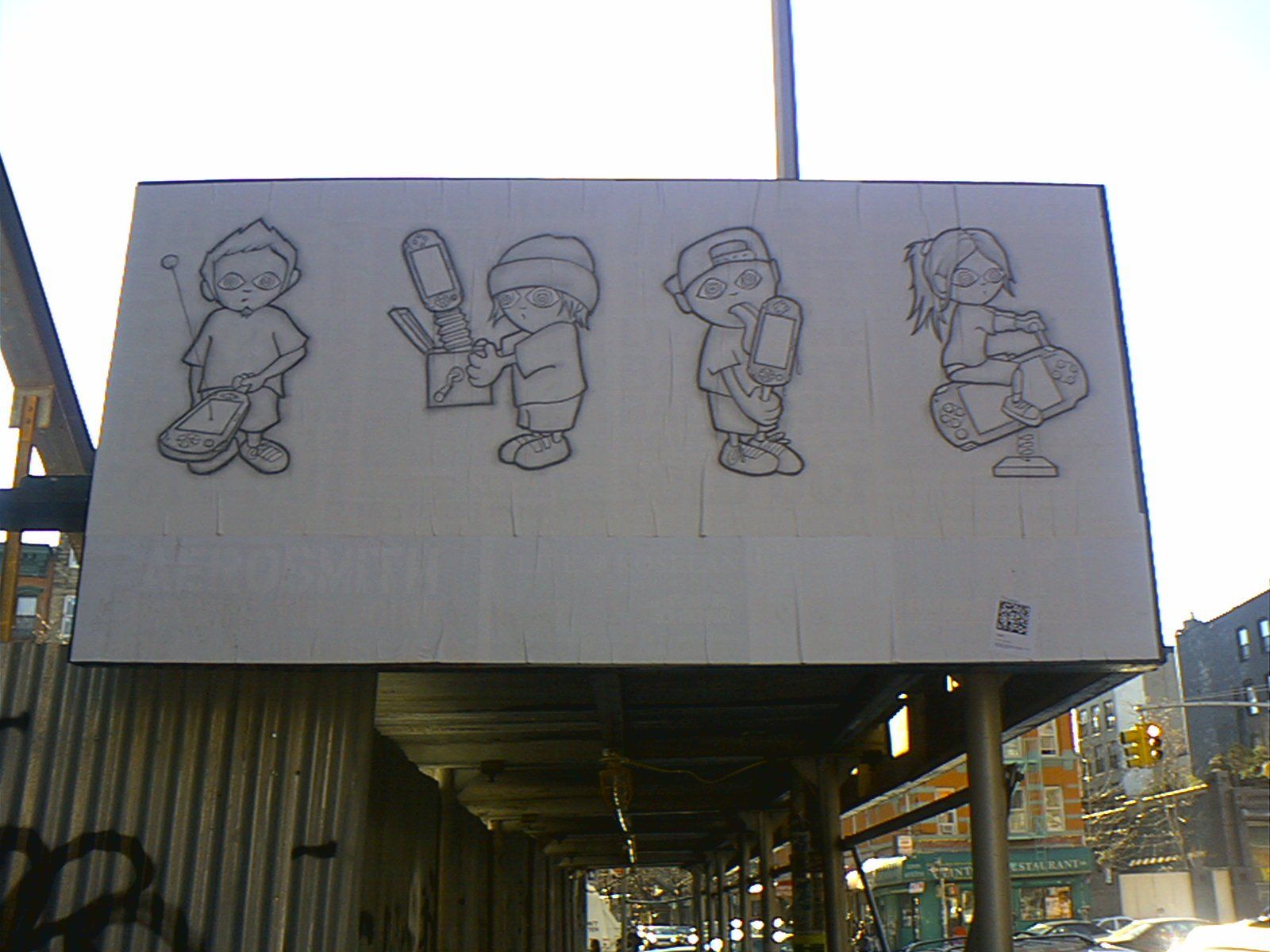
By the end of December the Associated Press described the finished look. In a report dated December 29, 2005, the ads showed cartoon characters using the PSP as a skateboard, a lollipop and a Jack-in-the-Box crank. There was no Sony or PlayStation branding. A version of the same AP story in the Spokesman-Review, datelined Philadelphia, says the art does not mention Sony or the PSP and gives no sign that it is an ad.
The Los Angeles Times, in a January 2, 2006 article by David Zucchino, described the same style as caricatures of wide-eyed children playing with video toys. The link is to a reprint on Arthur Magazine, not the original page.
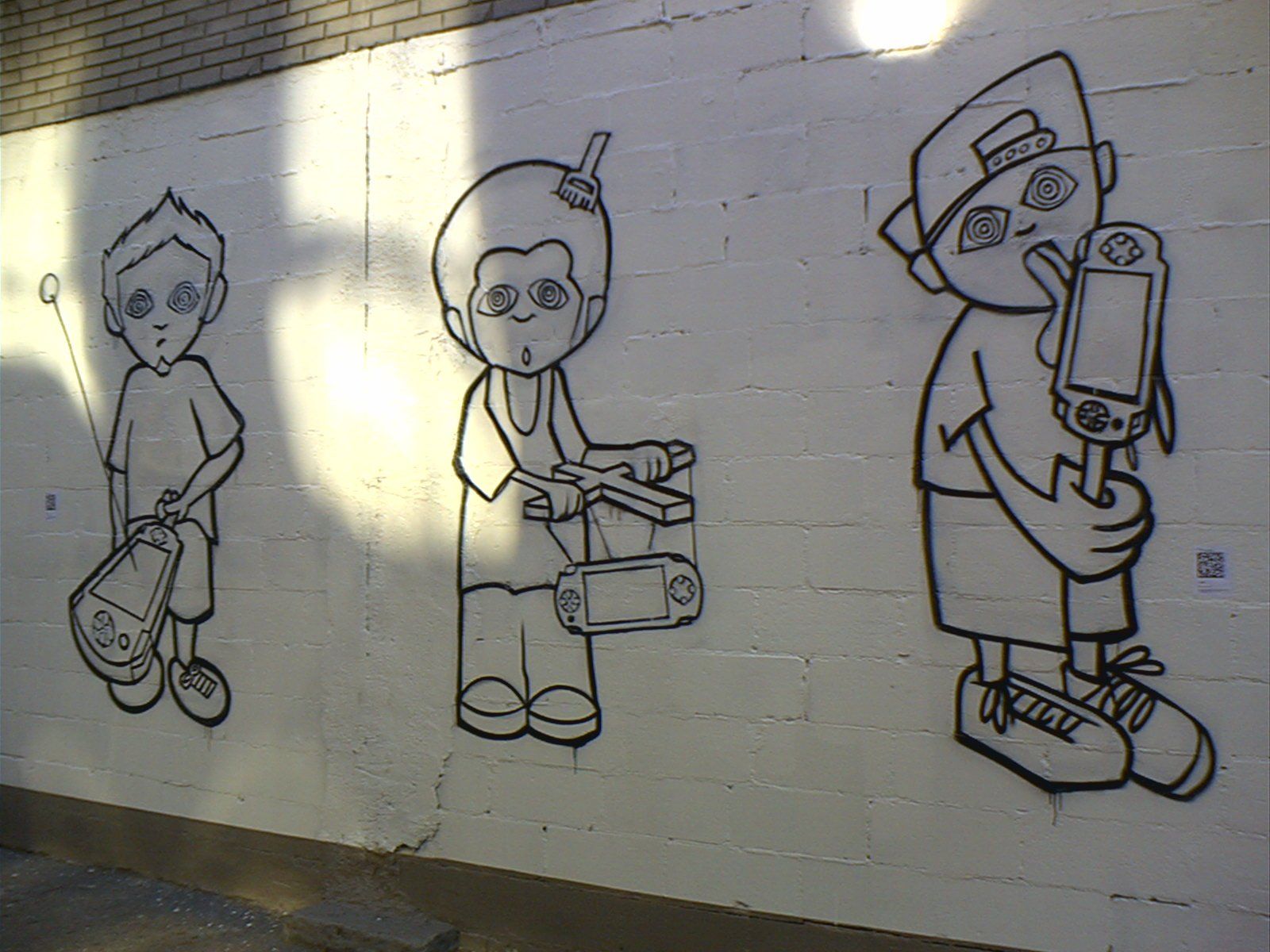
That is the whole trick. The ad does not look like an ad. It looks like something a local artist put up, and the only clue that a company paid for it is the sudden appearance of the same style in several cities at once.
Where it ran and who painted it
Sony spokeswoman Molly Smith said Sony hired artists in seven cities to spray-paint designs that were already drawn. The AP article names four: Atlanta, Los Angeles, Miami and Chicago. It also reports ads in San Francisco, New York and Philadelphia, where one went on the side of an abandoned building in North Philadelphia. The AP does not list all seven cities in one place.
Two details are worth stating carefully.
- The artists were hired, but not named. The AP reports that Sony hired artists. The Los Angeles Times quotes Mary Tracy of the anti-blight group Society Created to Reduce Urban Blight saying Sony hired local artists. No source names any of them.
- Some owners were paid. The Los Angeles Times reported that Philadelphia cited one building owner who was paid by Sony for ad space. The article does not give the fee or the number of walls leased.
No source names the advertising agency. Wooster Collective guessed an agency was involved, but that was its own assessment.
Why the cities objected
The objection was about advertising rules, not about the art. In Philadelphia, Mary Tracy told the AP that Sony ignored the city’s zoning process for outdoor commercial advertising, and said “They’re breaking the law.” Managing Director Pedro Ramos faxed a cease-and-desist letter to Sony Computer Entertainment’s US division in San Mateo, California. The AP reports he said the city could seek modest fines under city code or sue to recover profits from the ads, and that “My fines aren’t going to scare Sony.”
The Los Angeles Times adds more. It reports the city cited Sony for violating sign ordinances, ordered the ads removed and warned of fines for posting without a permit. A mayor’s spokesman, Joe Grace, said neither Sony nor the property owners had licensing or zoning approval, and called the ads “not only illegal” and “disrespectful to the community.” The same article says one downtown ad was painted over, apparently by an anti-graffiti group that may not have realized it was an ad.
That detail is the one I keep coming back to. A crew whose job is to remove graffiti treated a paid ad as graffiti, because it looked like graffiti. That is the same logic that sits behind the 2013 case I cover in the subway ad that was rejected for looking like graffiti.
This is a report of what officials said. It is not legal advice, and it states no conclusion about the law that the sources do not state.
How writers and neighbors reacted
The backlash came from the street, too. The AP reports that after word spread that Sony was behind the ads, one in San Francisco was defaced with “Get out of my city!!!” and “Fony,” a play on the company name.
In New York, former graffiti artist Jake Dobkin told the Los Angeles Times the ads were “fake and inauthentic.” He said dozens had appeared in SoHo and other parts of Manhattan, and posted photos of defaced ones on his Gothamist site, including one with a sticker reading “Corporate vandals not welcome.”
Reaction was not all negative. The AP quoted Eddie Torres, who works in a furniture shop near the Philadelphia wall, saying the ads target teens and calling them “sharp.” His reaction contrasts with the criticism from officials and street writers.
What Sony said
Sony said little. Molly Smith told Wired News that because the PSP is portable, the target was “urban nomads.” That line is quoted in both the AP story and, in slightly different words, the Los Angeles Times. No published report has Sony answering the Philadelphia letter or the city’s order, and no later Sony statement, retraction or outcome of any fine was reported, so how the dispute ended is unknown.
What it shows about brands and graffiti
I work in digital marketing in Los Angeles, and I paint, so I read this campaign two ways.
As a marketer, it is a smart bet on credibility. People trust a painted wall more than a billboard, and the ad’s lack of a logo made it feel like discovery. The risk is that it only works until someone finds out. The AP reports that the “Fony” tag appeared once the sponsor was known, and Dobkin’s criticism is that the ads were fake. The look carries trust only while viewers think it is real.
As someone who paints, I see the double standard. Sony paid for the look and got a city enforcement response aimed at the paperwork. Writers who paint without permission get a removal budget. For the numbers on that side, see Is graffiti art? What brand budgets say.
The same pattern shows up when brands take from artists instead of hiring them. Courts have heard cases where artists said fashion companies copied their murals, which I cover in brands copying graffiti: the Cavalli, Moschino and H&M lawsuits. The Sony campaign sits at the polite end of that spectrum: it paid. The full set of cases is on the hub page, graffiti lawsuits against brands.
This is also not a single event. In 2013, according to Hyperallergic, CBS Outdoor, which sells ad space on the outside of subway trains, rejected a novel’s ad because of its lettering and wrote that the MTA wants nothing that looks like graffiti. Eight years earlier, a major electronics brand was paying for exactly that look on walls. The look was a nuisance when no one paid for it and an asset when someone did.
What is still unknown
- No report names the ad agency or the artists.
- The fees paid for walls, and how many walls were leased, were never published.
- No single source lists all seven cities.
- Whether Philadelphia collected a fine was not reported.
If you have a primary source for any of these, write to me and I will update the post.
Artists mentioned
The artists and estates named in this post, with their own sites and Instagram accounts where I have confirmed them:
Sources
Retrieved 2026-10-30. Where a source is a reprint or a secondary account, the text above says so.
- Associated Press, Graffiti ads for PSP spark controversy, via NBC News, 29 December 2005.
- Associated Press, Ads disguised as graffiti spark controversy, via The Spokesman-Review, 30 December 2005.
- David Zucchino, Los Angeles Times, Sony Draws Reproach Over Graffiti-Style Ads, 2 January 2006, reprint on Arthur Magazine.
- Simon Carless, Report: Sony turns to street art to market PSP, Game Developer (Gamasutra), 17 November 2005.
- Jillian Steinhauer, MTA rejects advertising graffiti, Hyperallergic, 16 January 2013.
- Photos: Stan Wiechers, PSP Ad (wall) and PSP Ad (panel), 16 December 2005, CC BY-SA 2.0, via Flickr. Ad art by unnamed artists hired by Sony.
Frequently asked questions
What was the Sony PSP graffiti campaign?
A 2005 guerrilla advertising campaign for the PlayStation Portable. Artists painted or chalked black-and-white cartoon kids using a PSP as a skateboard, a lollipop and a Jack-in-the-Box crank on city walls. The art carried no Sony or PlayStation branding. It appeared before the holidays in 2005 in several large US cities.
Which cities did the Sony PSP graffiti ads appear in?
The Associated Press reported ads in Philadelphia, San Francisco and New York, and quoted a Sony spokeswoman saying Sony hired artists in seven cities, naming Atlanta, Los Angeles, Miami and Chicago. The Los Angeles Times reported activists saying the ads had appeared in six other cities besides Philadelphia. No source lists all seven together.
Did Sony pay for the walls?
In part, according to one report. The Los Angeles Times reported that Philadelphia cited a building owner who was paid by Sony for the ad space. No source states the fees, the number of walls or who negotiated the leases.
Was the Sony graffiti campaign illegal?
Philadelphia said so. The mayor's spokesman told the Los Angeles Times that neither Sony nor the property owners had licensing or zoning approval, and the city cited Sony for violating sign ordinances. A court would have set any fines. No response from Sony to those reports was published. This is a report of what officials said, not legal advice.
What is 'Fony' graffiti?
A one-word protest tag. The Associated Press reported that after word spread that Sony was behind the ads, one in San Francisco was defaced with 'Fony' and 'Get out of my city!!!'.
Who made the Sony PSP graffiti ads?
Sony's spokeswoman said it hired artists to spray-paint designs, and the Los Angeles Times quoted an anti-blight activist saying they were local artists. No source names the artists or confirms the ad agency.
What did Sony say about the campaign?
Sony spokeswoman Molly Smith said the target was people she called urban nomads, because the PSP is a portable product. Sony did not publicly answer the Philadelphia cease-and-desist letter or the city's removal order.
Is graffiti-style advertising still used?
Yes. In 2013 a publisher's subway ad for a novel was turned down because its lettering looked like graffiti, and brands have been sued over copying real artists' work. The wider pattern is that the look is treated as valuable by marketers and as a nuisance by cities. The related posts below cover those cases.